The New Website Playbook After AI Overviews: Why Ranking Is No Longer Enough
For years, a lot of website strategy followed a simple mental model: rank well, get clicked, convert the visitor.
That model is not dead. But it is no longer sufficient.
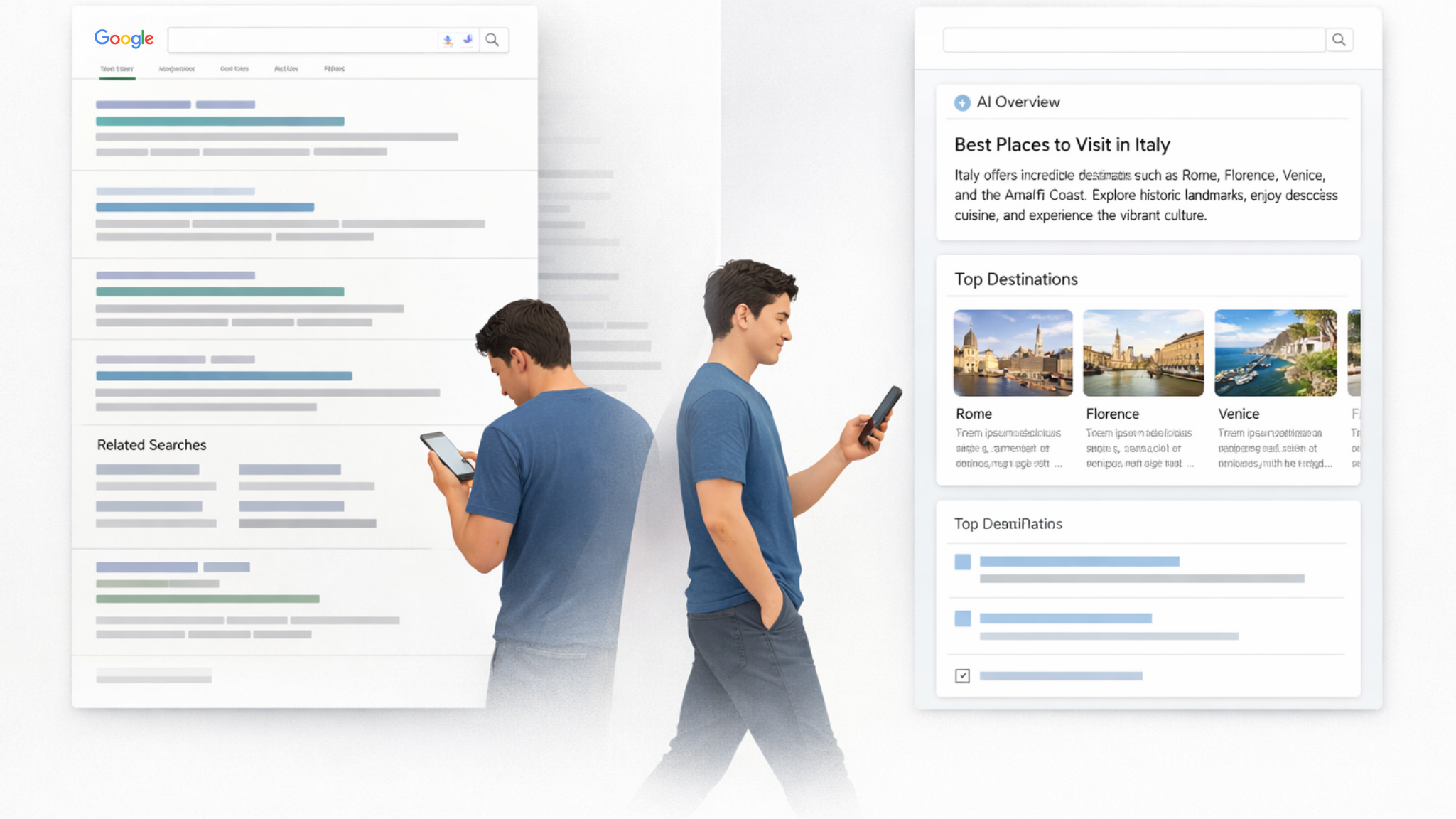
Google’s AI Overviews have changed the shape of the search results page, and with it, the way people discover information, compare options, and decide whether to visit a site at all. Google says AI Overviews now reach users in more than 200 countries and territories and over 40 languages, and that in major markets they are increasing usage for the types of queries where they appear.
That sounds exciting if you are Google.
For businesses, schools, and organizations that rely on their websites to generate trust and demand, the more important question is different:
What happens when your website is no longer the first place people go to get the basic answer?
Ranking still matters. But it is no longer the whole game.
In the older SEO model, being near the top of the organic results often meant strong visibility and a fair chance at traffic.
Now, AI-generated summaries can occupy a large share of the screen before the user even reaches the traditional results. Some industry studies are reporting substantial click-through declines when AI Overviews appear, though the exact size varies by dataset and methodology. Those numbers should be treated as market signals rather than universal law, but the direction is clear enough: visibility is being redistributed.
That means the goal is no longer just:
“Can we rank?”
It is also:
- Can we be understood quickly?
- Can we be cited or referenced?
- Can we earn trust before the click?
- Can our website still convert when traffic is lower but more selective?
That is a very different playbook.
The old website model was built for clicks. The new one must be built for decisions.
A lot of websites are still structured as if search works the way it did a few years ago.
You can see it everywhere:
- vague service pages
- bloated copy written for nobody in particular
- generic blog posts chasing keywords with all the charisma of wet cardboard
- weak metadata
- no clear point of view
- no proof
- no next step
That kind of content was already mediocre. In an AI-mediated search environment, it becomes even less useful.
If an AI system can summarize the obvious parts of your page in a few lines, then the pages that still matter are the ones that do more than state the obvious. They need to add clarity, credibility, structure, and decision value.
In plain English: your website has to help someone move forward, not just help you appear.
What businesses should do differently now
1) Write for decision-makers, not just search terms
A strong page now needs to answer the real business question behind the search.
Not just “What is SEO for schools?”
But:
- What changed?
- Why does it matter now?
- What is at risk if we ignore it?
- What should we do next?
If your pages do not reflect the actual concerns of a founder, school leader, operations manager, or marketing lead, they are easier to summarize and easier to skip.
2) Make structure do real work
Google’s own guidance continues to emphasize accuracy, quality, relevance, and strong metadata, including titles, descriptions, structured data, and alt text where appropriate. That is not glamorous, but it matters. The plumbing of a website is often what lets good content become visible and understandable.
This is where many sites quietly fail:
- weak page titles
- duplicated metadata
- unclear page hierarchy
- messy internal linking
- no schema where useful
- images with no descriptive context
- pages that mix three audiences and four intentions
Good structure does not guarantee performance. Bad structure reliably gets in the way of it.
3) Build pages that deserve citation, not just traffic
This is the big shift.
In an AI Overview environment, some value is created before the click. That means the best pages are not just optimized to attract traffic. They are designed to be useful enough, specific enough, and trustworthy enough to inform the answer layer itself.
That usually means:
- clearer expertise
- stronger topical focus
- better supporting detail
- better examples
- better evidence
- less filler
Thin pages are easy to ignore. Specific pages have a fighting chance.
4) Treat content like a conversion system, not a publishing hobby
If your blog exists only to “post regularly,” it will produce exactly what most corporate blogs produce: a pile of tidy irrelevance.
Content now needs a job.
A good article should do at least one of these:
- help the right buyer understand a changing reality
- clarify a common mistake
- frame a practical decision
- show your point of view
- build trust for a relevant next step
This is especially important for service businesses. Lower-volume, higher-intent traffic can still be valuable if the site is built to convert that attention into a credible business conversation.
5) Stop separating SEO, UX, and messaging as if they are unrelated
This separation was never that smart, and now it is actively unhelpful.
If your SEO person is chasing queries, your designer is chasing aesthetics, and your sales message is hiding in a PDF no one reads, the website will feel fragmented. And fragmented websites are harder to understand, harder to trust, and harder to act on.
The stronger model is integrated:
- search intent informs content
- content informs structure
- structure supports UX
- UX supports clarity
- clarity supports conversion
That is the real growth stack now.
What this means for education organizations and growing businesses
Education is especially interesting here. Recent analyses suggest AI Overviews have been growing strongly in education-related query sets, which means schools and education organizations may face increasing pressure to make their websites more decision-useful, not just more informative.
For schools, that can affect:
- admissions discovery
- program comparison
- parent trust
- visibility for non-branded searches
- how clearly the site explains real differentiators
For growing businesses, the same logic applies:
- commodity pages become easier to bypass
- generic content becomes easier to compress
- trust signals matter more
- the website needs to carry clearer commercial intent
In both cases, the question is no longer whether your website exists.
It is whether it helps the right visitor decide.
The practical shift
The new website playbook is not “do more SEO.”
It is:
- improve technical clarity
- improve content specificity
- improve page intent
- improve proof and trust signals
- improve conversion paths
- align site structure with real business questions
That is how websites stay useful when search becomes more mediated, more compressed, and more answer-driven.
Because in this environment, the winners are not just the pages that rank.
They are the pages that help people move from curiosity to confidence.
Is your website still built for rank and wait?Request an SEO Growth Audit